
What is a thermostat?
Thermo-stat
The word "thermostat" is a compound of "thermo" meaning temperature or heat, and "stat" meaning to keep something constant.
"Thermo" is the English pronunciation, while in German it is pronounced "termo" or "term".Purpose
| Temperature regulator (controller) | Maintains a certain degree of temperature |
|---|---|
| Overtemperature protection device (limiter / protector) | Cuts off the heat source when the temperature rises above the intended level. |
| Temperature detector. | Provides a signal or triggers another operation, when the set temperature has been reached. These are the main purposes of a thermostat. |
Asahi thermostats are bimetal thermostats.
A bimetal thermostat is a temperature switch that senses temperature using a bimetal and opens or closes an electrical circuit (ON/OFF) by actuating contacts. There are many types of devices and elements used to control or measure temperature.
What are the principles of bimetal?
The principle of a bimetal is based on the fact that two different metals have different coefficients of thermal expansion. When the temperature changes, the metals expand or contract at different rates, causing the bimetal strip to bend or twist. This characteristic makes bimetals widely used in temperature detectors and temperature control devices. For example, in a thermostat, the bimetal disck bends in response to a specific temperature and opens or closes an electrical circuit to control temperature. Other applications include thermometers, fire alarms, and overheat protection devices. This operation of bimetal is highly reliable and provides a simple yet effective mechanism for a wide range of applications.-
-
Bimetal
Two metals (a low-expansion metal and a high-expansion metal) are bonded and rolled into a single sheet → Bimetal.
-
-
-
Etymology
"Bi" is a prefix meaning "two" and "metal" means metal.
-
-
-
Bonding
The metals are bonded by cold rolling, hot rolling, or similar processes, creating a metallurgical (atomic) bond. (No adhesive is used.)
-
-
-
Materials
The high-expansion side consists of an iron (Fe) and nickel (Ni) alloy, with small amounts of metals such as Cr, Mn, and Mg. The low-expansion side is Invar (Ni36-Fe). In other words, the principal components of both the high-expansion and low-expansion sides are iron and nickel.
-
-
-
The bimetal bends in one direction as the temperature rises and bends in the opposite direction as the temperature falls.
-
-
-
When its movement is restrained, the bimetal generates [force] proportional to the degree of restraint.
In a thermostat, this force is used to overcome the contact pressure and operate the switching contacts.
-
Structures of bimetals.
US-622 ON/OFF Operation
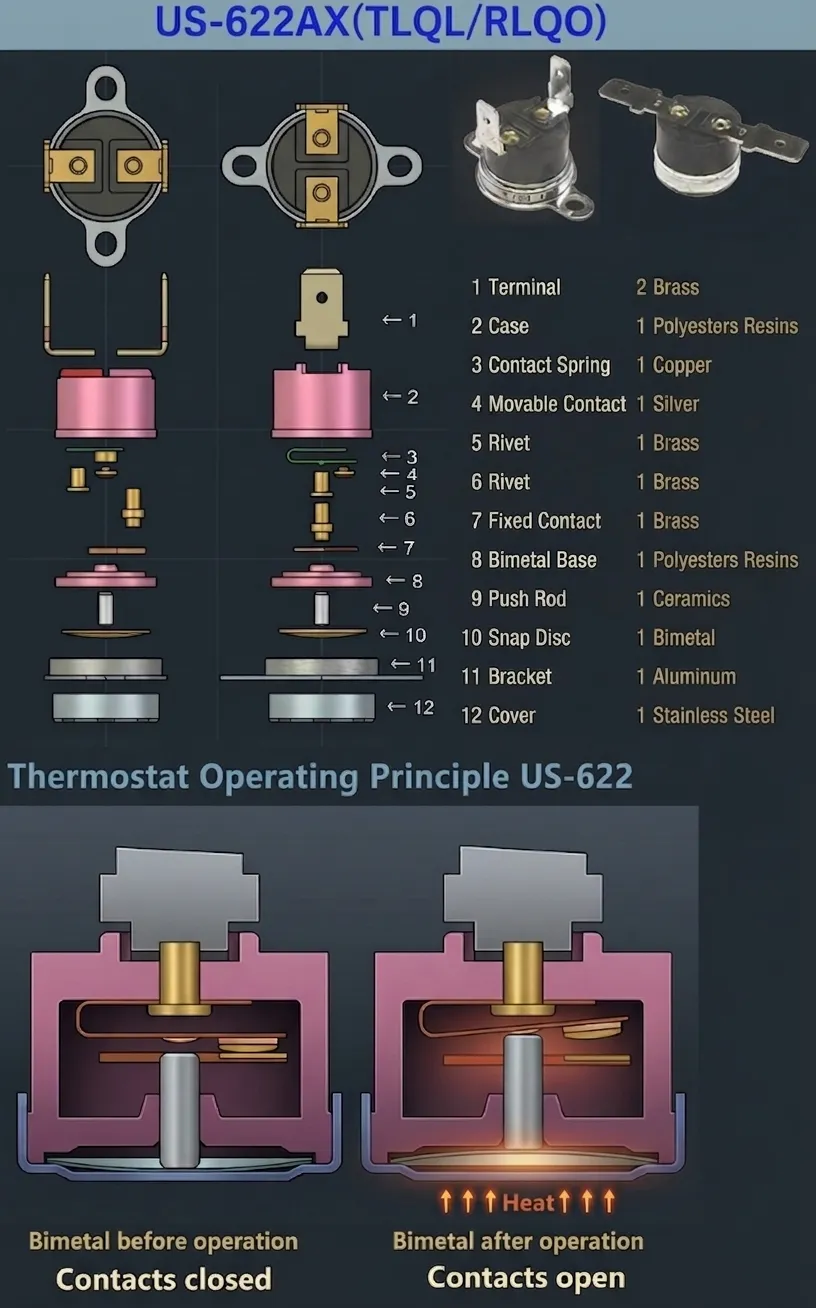
Click the image to view a larger version
Types and Purposes of bimetals.
Types and Structures
| Laminated type | In this type, components are stacked and riveted together. It provides a small differential temperature and allows adjustable-temperature designs. |
|---|---|
| Snap disc type | In this type, components are assembled inside a plastic or ceramic case and covered with a protective cap. Although the differential temperature is somewhat larger, the use of a low-cost snap disc makes this type well suited for overtemperature protection. |
| Protector type | In this type a snap disc is incorporated into an electrical circuit and enclosed by a case and cover. In addition to temperature, it can also detect electrical current. Used for overtemperature and overcurrent protection. |
Applications
| Home Electrical Appliances | Kitchen appliances (electric water boilers, coffee makers, ovens, hot plates, rice-cake makers, etc.) Heating appliances (electric heaters, electric warming pads, electric kotatsu, panel heaters, electric heating mats, etc.) Others (irons, hair dryers, vacuum cleaners, futon dryers, etc.) |
|---|---|
| Household appliances | Heated toilet seats, floor-heating systems, battery chargers, etc. |
| Gas and oil | Bath heaters, water heaters, fan heaters, stoves, etc. |
| Others | Copy machines, vending machines, automobiles, motorboats, personal watercraft (jet skis), etc. |
| Industrial Equipment | Construction tools, road signs, welding machines, etc. |